Afe Babalola Centre, Nairobi Continental Hub Safeguarding Policy
PURPOSE & SCOPE
The African Leadership Centre (ALC) entered an Agreement with King’s College London (KCL) to establish the Afe Babalola Centre (ABC) Continental Hub to deliver a series of programmes aimed at providing world-class education opportunities to talented young African students. Clause 13 of the Agreement sets out the safeguarding requirements the ABC Continental Hub must have in place to deliver the programmes.
This policy sets out the approach of the ABC Continental Hub to safeguard any ‘Child’, ‘Adult at risk’ or ‘Affected Population’ who is admitted as a student on the ABC programmes delivered through the Continental Hub (including short courses).
· If the student is a KCL student: King’s Safeguarding Policy applies and responsibility falls with respective academic teams and the ABC Central Team.
· If the student isenrolled on short courses through the ABC Continental Huband is not a KCL student: This policy applies, and responsibility falls with the ABC Continental Hub.
The policy provides information to enable ABC Continental Hub staff and students to identify instances in which there are grounds for concern about the welfare of a student enrolled in an ABC short course whether arising from home, community, or the short course environment, and to understand the appropriate actions to take to keep them safe.
The ABC short courses are being delivered through an online learning environment. However, there are instances where ABC Continental Hub staff and Learning Support Officers will interact with students enrolled on ABC short courses through technological and learning support.
The ABC Continental Hub takes a wholistic approach to safeguarding and ensures the welfare of Children, Adults at risk, and all students from Affected populations is paramount.
DEFINITIONS
The ABC Continental Hub has a responsibility to safeguard the welfare of Children or Adults at risk and Affected populations. However, children will not be enrolled in ABC programmes and therefore safeguarding will unlikely apply in this context.
In alignment with the KCL Safeguarding definitions, the following definitions apply:
• Safeguarding: taking all reasonable steps to prevent harm, particularly sexual exploitation, abuse and harassment from occurring; to protect people, especially adults at risk and children, from that harm; and to respond appropriately when harm does occur.
Safeguarding in an international context refers to any abuses of power including sexual exploitation, sexual abuse or harassment, plus any broader forms of violence, exploitation and abuse such as bullying, psychological abuse and physical violence.
- Child/Children: A person/people under the age of 18.
- Adults at Risk: An adult at risk is any person aged 18 or over who is or may be in need of community care services by reason of mental or other disability, age or illness; and who is or may be unable to take care of themself, or unable to protect themself against significant harm or exploitation.
- Affected populations: Anyone who can be exploited through an imbalance of power. This includes, but is not limited to:
o Students
o Anyone who directly receives goods or services from our programmes
o Anyone who potentially may receive some development assistance through our programmes.
o Research participants, and anyone involved in research projects.
o Patients at health facilities.
- Sexual Exploitation and Sexual Abuse: Sexual exploitation means any actual or attempted abuse of a position of power or trust for sexual purposes. Sexual abuse can be actual or threatened, whether by force or under unequal or coercive conditions.
· Bullying and Harassment: Harassment is unwanted behaviour that violates a person’s dignity or creates an intimidating, hostile, degrading, humiliating, or offensive environment for that person. Bullying may be characterised as offensive, intimidating, malicious or insulting behaviour, or an abuse of power in ways intended to undermine, humiliate, denigrate or injure the recipient.
PREVENTION
A key focus of international safeguarding is ensuring safe recruitment practices that help to avoid hiring any persons that may pose a safeguarding risk.
DBS Checks or alternative criminal background check
All team members that have direct contact with students, must take a DBS or local relevant criminal background check as part of their onboarding process. Line Managers are responsible for ensuring existing staff undertake a check as required. Two-character reference letters from previous employers or academic supervisors are considered a sufficient equivalent background check.
TRAINING
During the onboarding process all the ABC Continental Hub staff including DSOs, LSOs and ABC Central DSO must undertake appropriate level of safeguarding training.
PERSONAL RELATIONSHIPS
It is prohibited for a ‘relevant staff member’ to enter into an intimate relationship with a student. A ‘relevant staff member’ is a member of staff who has direct responsibilities in relation to a student, including teaching, assessment, supervision or provision of pastoral support. In the context of ABC short courses, Learning Support Officers will have a professional role providing learning and pastoral support to enrolled students, and this requirement therefore applies in line with the KCL Personal Relationships between Staff and Students Policy.
ROLES AND RESPONSIBILITIES
Designated Safeguarding Officer (KCL DSO) – Centre Manager, ABC at King’s
Responsible for ensuring the ABC Continental Hub meets all safeguarding requirements under the Agreement, if appropriate, escalating concerns to the KCL Chief Safeguarding Officer, completing criminal background checks every three years, and undertaking FCDO safeguarding training with awareness of the international legal context.
Designated Safeguarding Officer (ABC DSO) – Hub Coordinator, ABC Continental Hub
Ensures all relevant individuals are familiar with the safeguarding policy and trained accordingly, maintains a log of incidents, if appropriate, report concerns to the KCL DSO, completes criminal background checks or equivalent every three years, and undertakes FCDO safeguarding training with legal awareness.
Learning Support Officers (LSOs) – ABC Continental Hub
Required to understand and follow safeguarding procedures, provide character references, attend safeguarding briefings and training, report any safeguarding concerns to the DSO, and fully cooperate with investigations.
REPORTING PROCEDURES
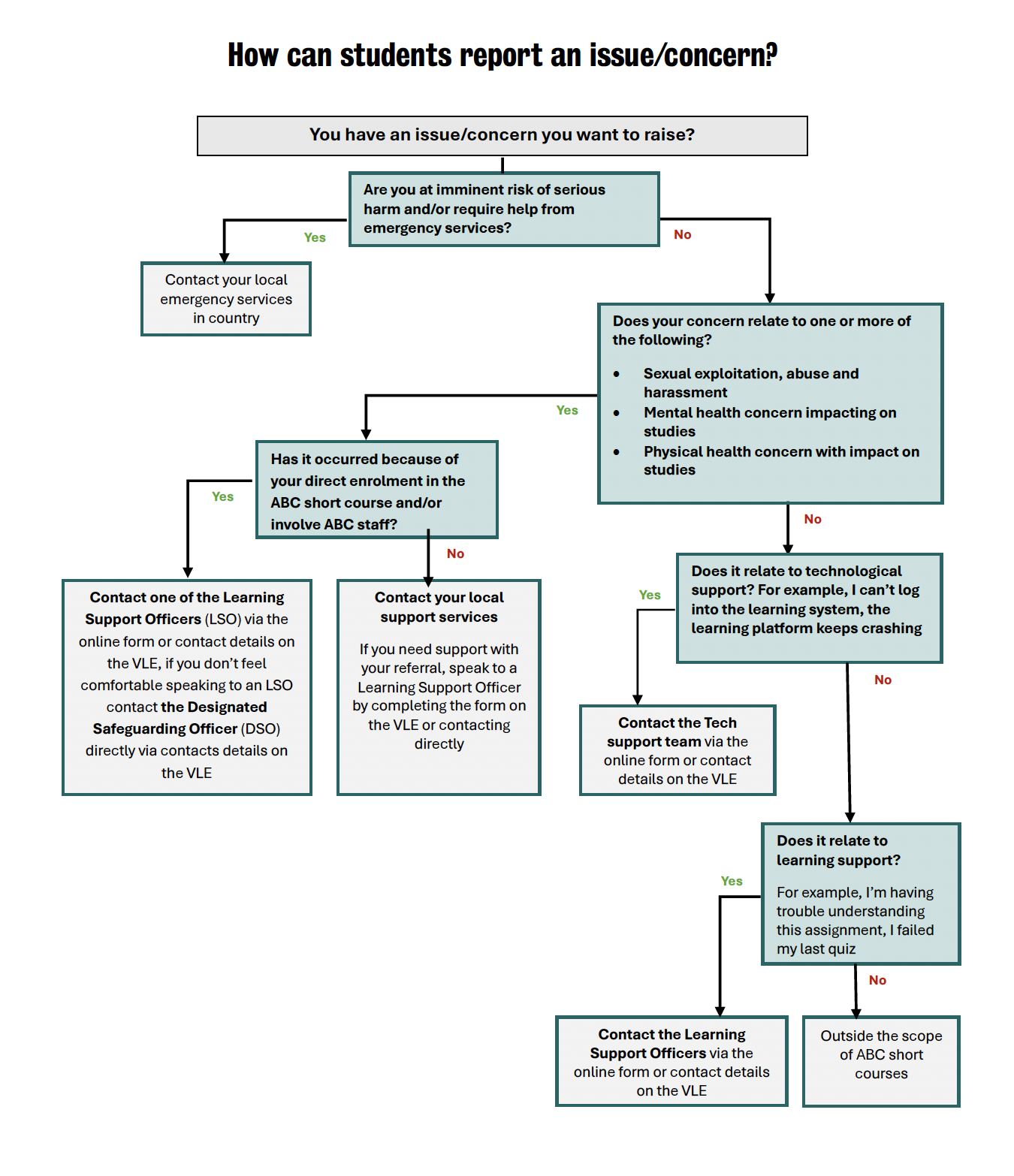
Learning Support Officers must report safeguarding concerns (confirmed or suspected) about any individual connected with short courses as quickly as possible and within 24 hours to the ABC DSO. Depending on the type of safeguarding report made by the LSO, the process to address the report may differ.
The ABC DSO must report any confirmed significant safeguarding incidents or concerns received to the KCL DSO.
LEGAL CONTEXT AND RELATED POLICIES
This policy is informed by the KCL Safeguarding policy and a collection of UK legislation and guidance on the protection of Children and Adults at Risk. All staff are responsible for understanding the legal context in the UK and in their local context in country.
NON-COMPLIANCE
The ABC Continental Hub expects all staff, students, and associated personnel representing the Hub or who contribute to its activities to follow the Safeguarding policy and to promote the welfare of Children, Adults at Risk and people from Affected populations. Failure to follow this guidance and procedures may not necessarily constitute abuse, but it is nonetheless a matter of concern for the Hub and may lead to disciplinary action.
If an individual is concerned that another member of the Hub is not following the guidance and procedures, they should contact their own line manager, or Designated Safeguarding Officer.
INFORMATION SHARING AND CONFIDENTIALITY
In general, information should only be shared with the consent of the subject of the information. However, in some circumstances, it will be inappropriate to seek consent before sharing information with others and/or information can be shared where consent has been refused, for example:
- Emergency or life-threatening situations that place the Child, Adult or others at increased risk of significant harm; or
- Where seeking consent might undermine the prevention, detection or prosecution of a serious crime (i.e. any crime which causes or is likely to cause significant harm to a Child or to an Adult), or interfere with a potential investigation.
If an individual refuses intervention to support them with a Safeguarding concern, their wishes should be respected. However, there are circumstances where this request can reasonably be overridden, including:
- the individual lacks the mental capacity to make that decision
- other people are, or may be, at risk, including Children. This is particularly pertinent when dealing with disclosures about domestic abuse and violence
- sharing the information could prevent a crime
- alleged abuser has care and support needs and may also be at risk
- serious crime has been committed
- staff are implicated
- the person has the mental capacity to make decisions, but they may be under duress or being coerced to refuse intervention.
POLICY REVIEW
It is the responsibility of the Designated Safeguarding Officer (ABC Continental Hub) to review this policy annually. The ABC Continental Hub will further develop the policy where necessary in line with the changes in legislation and best practice guidance and following internal review of the effectiveness of existing procedures.